Speaking ability is six skills, not one. When someone says "she's a great speaker," they're actually observing a combination of how well that person organizes ideas, how efficiently they express them, how much conviction they project, how clearly they pronounce words, how few verbal fillers they use, and how well they control their pacing. These six dimensions can be evaluated separately and trained separately.
Most speaking advice treats communication as a monolithic talent you either have or you don't. That framing is unhelpful. A speaker can have excellent structure and terrible pacing. Another can be wonderfully concise yet muffled by poor articulation. Treating speaking as one skill means you can't diagnose what's actually holding you back. For a practical guide to improving across all six dimensions, see how to articulate your thoughts better.
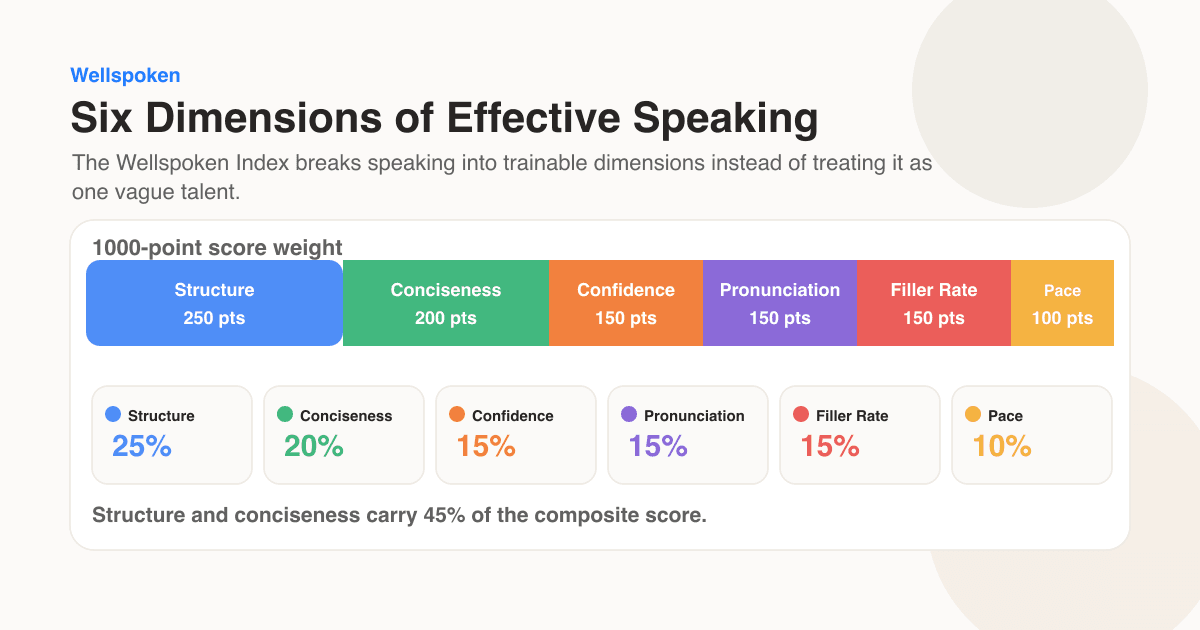
The Wellspoken Index breaks effective speaking into six dimensions scored across 1000 total points. Each dimension has a weight inside Wellspoken's coaching framework.

What Makes Someone a Good Speaker?
A good speaker tends to show balance across the six Wellspoken Index dimensions: Structure (250 pts), Conciseness (200 pts), Confidence (150 pts), Pronunciation (150 pts), Filler Rate (150 pts), and Pace (100 pts). Balance across dimensions matters more than perfection in any single one.
Consider two speakers at a quarterly business review. Speaker A has a commanding voice, perfect posture, zero filler words, and crystal-clear diction. Impressive delivery. The problem: her ideas jump between five unrelated points with no connective thread. The audience remembers her presence but can't recall her message.
Speaker B has a slightly lower volume and occasionally says "um." He leads with his recommendation, supports it with two data points, and finishes in 90 seconds. The audience remembers exactly what he proposed and why.
Speaker B would score higher in the Wellspoken Index framework. Structure and conciseness carry more weight than any single delivery signal because a listener needs to understand the message before delivery polish can help it land.
How Do You Measure Speaking Ability?
You measure speaking ability by evaluating each of the six dimensions independently, then combining them into a composite score. The Wellspoken Index does this on a 1000-point scale, but the framework works even as a self-assessment lens.
Here's the weight distribution:
- Structure: 250 points (25%)
- Conciseness: 200 points (20%)
- Confidence: 150 points (15%)
- Pronunciation: 150 points (15%)
- Filler Rate: 150 points (15%)
- Pace: 100 points (10%)
The ordering is intentional inside Wellspoken's scoring framework. What you say and how efficiently you say it, Structure and Conciseness, make up 45% of the score. How you deliver it, Confidence, Pronunciation, Filler Rate, and Pace, makes up the remaining 55% across four separate dimensions because delivery is multifaceted.
Dimension 1: Structure, the Foundation of Being Understood
Structure is how logically you organize your ideas, and it carries the heaviest weight at 250 points. A well-structured response has a clear opening point, supporting evidence in a logical sequence, and a defined conclusion.
"I think the Jenkins proposal is strong for three reasons. First, their timeline aligns with our Q3 launch. Second, their pricing came in 20% under the next closest bid. Third, they're the only vendor with experience in our regulatory environment. I recommend we move forward."
That took 12 seconds to read. Every sentence advanced the argument. The listener could repeat the three reasons back immediately. That's structure at work.
Organized speech is easier for listeners to follow because human working memory can hold only a few chunks of information at once. Structured speech pre-chunks information for the listener, reducing their cognitive load.
Why structure ranks highest. You can have perfect delivery, zero fillers, and beautiful pacing, but if your ideas come out in random order, your listener has to mentally reorganize everything you said. Most won't bother. They'll nod politely and forget your point within minutes. People retain what they hear first and last, and lose most of the middle. Structure lets you place critical content at those high-retention points deliberately.
Start improving structure today with a simple habit: before you speak, silently identify your main point and lead with it. Read our full guide on how to structure your thoughts before speaking.
Dimension 2: Conciseness, Saying More with Less
Conciseness is the efficiency of your expression, measuring how much meaning you deliver per word. It's weighted at 200 points because brevity and clarity are tightly linked.
Here's a real example. Verbose version: "So what I'm basically trying to say is that we probably need to, at some point in the near future, start thinking about and planning for the possibility that our current infrastructure might not be totally sufficient for the upcoming growth that we're expecting to see."
Concise version: "Our current infrastructure won't support projected growth. We need to start scaling this quarter."
The verbose version is 50 words. The concise version is 17. The concise version communicates more because it eliminates hedges, qualifiers, and redundant phrasing.
Cutting important details makes you incomplete. Cutting filler, hedging language, and restated ideas makes you sharper. One widespread error in workplace communication is telling listeners everything you know instead of everything they need to know, a pattern cognitive psychologists call "information bias."
Why conciseness ranks second. Professionals spend the vast majority of their workweek communicating. When you multiply unnecessary words across thousands of daily interactions, the accumulated cost to attention and productivity is enormous. Executives consistently rank concise communication as a top trait of high performers.
Conciseness improves rapidly with practice. Learn how to be more concise when you talk.
Dimension 3: Confidence, How Conviction Shapes Perception
Confidence is the vocal and verbal presence you project, weighted at 150 points. This dimension captures volume, intonation patterns, hedging language, and overall energy. Listeners form competence judgments within seconds, and confidence signals are among the first things they process.
Same recommendation, two deliveries. Low confidence: "I mean, this is just my opinion, but I sort of think maybe we could consider looking at Vendor B? If that's okay with everyone, I guess." High confidence: "I recommend Vendor B. They deliver faster and cost less. Here's the comparison."
The content is identical. The perception is completely different. Falling vocal intonation, where pitch drops at the end of a statement, usually sounds more settled than rising intonation on a statement. Listeners form quick impressions from voice, wording, and pacing before they have time to analyze every detail.
What confidence measures. Confidence in the Wellspoken Index has nothing to do with personality type. Introverts can score as high as extroverts. The dimension measures specific, observable behaviors: steady volume, declarative intonation, absence of hedging phrases ("I think maybe," "sort of"), and appropriate pacing. All trainable mechanics.
Build a stronger vocal presence with specific techniques in our guide on how to speak with confidence.
Dimension 4: Pronunciation, the Clarity Layer
Pronunciation measures how clearly and accurately you articulate words, weighted at 150 points. It covers enunciation (distinctness of each syllable), articulation (physical accuracy of sounds), and word stress patterns.
This dimension is intended to focus on intelligibility rather than accent identity. Everyone has an accent, and accents are a natural part of language. Pronunciation here measures how clearly a speaker articulates words and sounds in spontaneous speech.
Think of pronunciation as the audio quality of a podcast. The content can be brilliant, but if the recording is muffled, listeners tune out. Mumbled consonants, dropped word endings, and inconsistent volume function the same way as a bad microphone.
Why pronunciation carries 150 points. Poor articulation forces the listener into a constant low-level struggle to decode words, draining the attention they'd otherwise spend understanding your argument. Over a 30-minute meeting, that cognitive tax compounds.
Most people have 2 to 3 specific articulation habits that account for the majority of their clarity issues. Learn how to improve your pronunciation and clarity.
Dimension 5: Filler Rate, the Verbal Static
Filler rate measures the frequency of verbal fillers, words like "um," "uh," "like," "you know," and "so," weighted at 150 points. Occasional fillers are normal. Excessive fillers erode perceived competence and impair listener comprehension.
A study in Advances in Physiology Education found that excessive filler use in presentations reduced speaker credibility and impaired audience comprehension. The study identified a tipping point: when fillers exceeded roughly 1.3% of total words, communication effectiveness dropped proportionally.
Filler-heavy speech can make a speaker sound less prepared even when the underlying point is strong. Delivery smoothness shapes how easily listeners stay with the message.
The nuance. Filled pauses ("um," "uh") and discourse markers ("like," "you know") function differently. Filled pauses signal retrieval difficulty, your brain searching for the next word. Discourse markers are conversational habits. Both register with listeners, but the intervention strategies differ. For filled pauses, replace with silence. For discourse markers, build awareness of your specific overused words.
Why it gets 150 points. Filler rate is the most immediately noticeable dimension and one of the fastest to improve because awareness alone produces rapid change. Most people have no idea how often they use fillers until they hear a recording.
Read our guide on how to stop saying um, uh, and like.
Dimension 6: Pace, the Speed and Rhythm of Delivery
Pace measures your speaking speed and variation, weighted at 100 points. Wellspoken looks at both average speed and pacing variation because a useful speaking pace depends on the context, pause patterns, and whether the transcript is measured as overall WPM or active WPM.
Two extremes: a speaker at 200+ wpm sounds rushed and anxious, overwhelming the listener's processing capacity. A speaker below 110 wpm sounds hesitant, and listener attention drifts.
Speed variation matters more than average speed. The best speakers speed up slightly during narrative passages, slow down for key points, and use strategic pauses to let critical ideas land. This rhythmic variation is what separates polished speakers from flat ones.
Why pace carries 100 points. Pace is weighted lowest because its impact, while real, is less dramatic inside a comfortable range. The weight catches the extremes and rewards variation, since monotone pacing can reduce engagement even when the average speed is reasonable.
Find your ideal speaking rhythm with targeted exercises. Learn how to find your ideal speaking pace.
How the Six Dimensions Work Together
The Wellspoken Index works because the six dimensions are complementary. Strong structure without conciseness produces organized speeches that run too long. Confidence without structure produces charismatic speakers who say nothing memorable. Fast pace without clear pronunciation produces rapid yet unintelligible delivery.
The highest-scoring speakers tend to share a pattern: they're balanced. They rarely max out a single dimension. Instead, they score in the top third across all six. One weak dimension creates a bottleneck that limits the impact of the strong ones.
The practical takeaway: identify your lowest-scoring dimension and focus there first. A 30-point improvement in your weakest area has more impact than a 30-point improvement in your strongest.
Key Takeaway
Effective speaking is six trainable skills: Structure (250 pts), Conciseness (200 pts), Confidence (150 pts), Pronunciation (150 pts), Filler Rate (150 pts), and Pace (100 pts). The Wellspoken Index turns those skills into a 1000-point practice score and helps you decide which dimension to train next.
FAQs
Which speaking dimension should I improve first?
Start with whichever dimension drags your overall communication down the most. For most people, that's structure or filler rate. Structure carries the highest weight and the most dramatic impact on whether listeners understand your message. Filler rate responds quickly to awareness-based practice.
Can you really measure speaking ability with a number?
A score captures specific, observable dimensions of speech, just like a credit score captures specific financial behaviors. The six Wellspoken Index dimensions give you a starting point and a way to track progress over time.
How long does it take to improve across all six dimensions?
Improvement depends on the starting point, the drill, and how consistently you practice. Recording yourself and reviewing playback gives you the feedback loop needed to notice patterns and adjust.
Measure all six dimensions of your speaking with the Wellspoken Index. Download Wellspoken
