The Wellspoken Index is a 1000-point coaching score that measures six trainable parts of professional speaking: Structure, Conciseness, Confidence, Pronunciation, Filler Rate, and Pace.
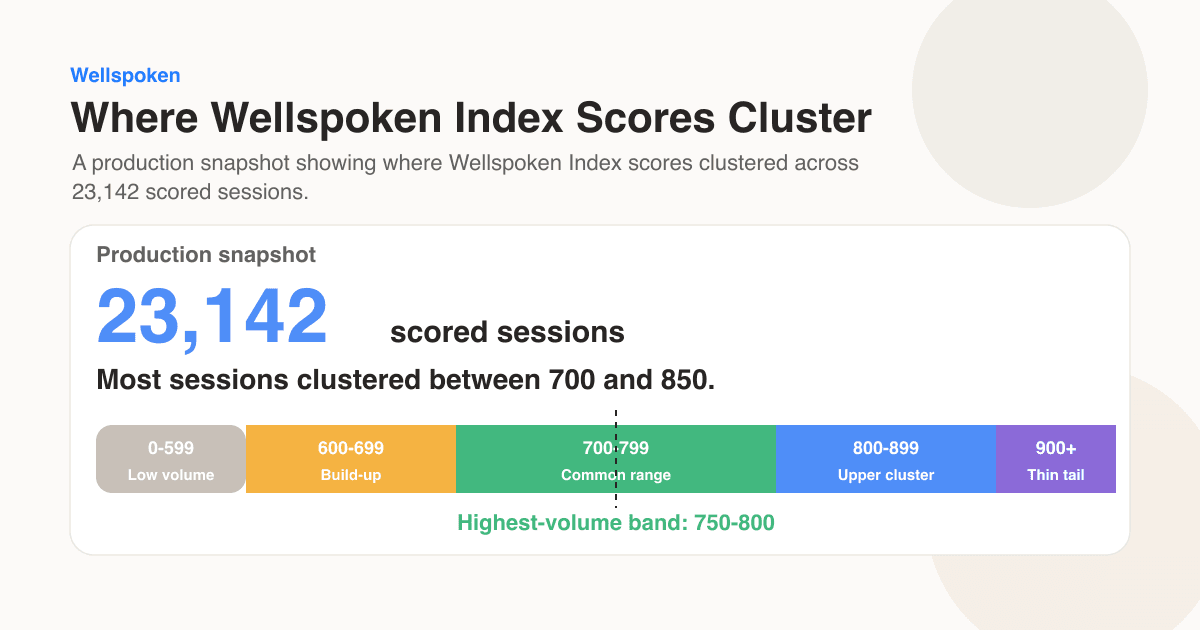
Across a recent production snapshot, Wellspoken analyzed 23,142 scored speaking sessions. The highest-volume score band was 750-800, with 7,025 sessions in that range. The 90th-percentile score ranged from 832 to 859 depending on the session type.
In one line:
Structure 250 + Conciseness 200 + Confidence 150 + Pronunciation 150 + Filler Rate 150 + Pace 100 = 1000 points.
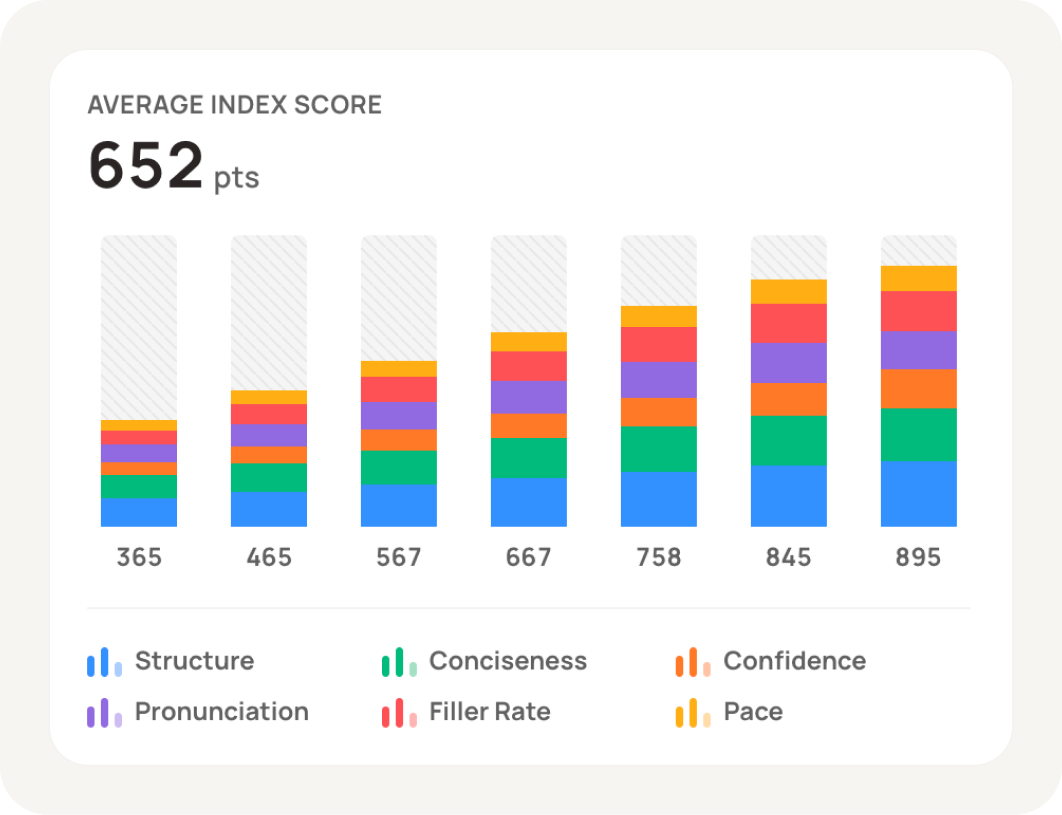
The goal is simple: turn "you sounded good" or "that was hard to follow" into a specific practice plan. If Structure is low, work on sequence. If Conciseness is low, compress the answer. If Filler Rate is low, practice cleaner transitions. A single score gives the headline. The dimension breakdown tells you what to do next.
What Does the Wellspoken Index Measure?
The Index weights the score this way:
| Dimension | Points | What it asks |
|---|---|---|
| Structure | 250 | Did the ideas follow a clear sequence with a strong opening and ending? |
| Conciseness | 200 | Did the speaker make the point efficiently without over-explaining? |
| Confidence | 150 | Did the transcript and language patterns show hedging, assertiveness, and sentence-ending confidence? |
| Pronunciation | 150 | Were the words and sounds intelligible enough to follow easily? |
| Filler Rate | 150 | How often did fillers appear relative to the length of the recording? |
| Pace | 100 | Was the speaker's speed and pause timing easy to follow? |
These dimensions match a durable pattern in formal speaking assessment: strong speech is multi-dimensional. IELTS Speaking Band Descriptors separate fluency and coherence, lexical resource, grammar, and pronunciation. TOEFL iBT Speaking uses structured tasks and scoring guides that include delivery, language use, and topic development. ETS SpeechRater uses speech recognition and analysis to evaluate spoken English proficiency. CEFR documents organize language ability through levels, activities, and quality descriptors.
Wellspoken uses that same broad idea, then adapts it for daily coaching. The Index is designed for fast practice feedback across work conversations, drills, interviews, explanations, meetings, and unscripted answers.
How Is the Wellspoken Index Calculated?
The Index combines two kinds of signals:
- Deterministic speech metrics, including filler counts, pace, pause patterns, words per minute, and pronunciation clarity when audio assessment is available.
- AI evaluation of higher-level communication quality, including structure, confidence, and conciseness.
Those signals are scored inside the six dimensions and then weighted into a 1000-point composite. The score is meant to be read with the dimension scores, because two speakers can land on the same total for very different reasons.
| Score pattern | Likely practice priority |
|---|---|
| High pronunciation, low structure | The words are clear, and the answer needs a better sequence. |
| High structure, low conciseness | The idea is organized, and the answer runs too long. |
| High conciseness, low confidence | The answer is efficient, and hedges or sentence endings weaken it. |
| Low filler rate score | The speaker needs awareness of filler clusters and transition points. |
| Low pace score | The speaker may be rushing, dragging, or pausing in distracting places. |
"Practice speaking" is too broad to be useful. "Spend this week improving structure and conciseness" is actionable.
Score your next 60 seconds and see which dimension is holding you back. Download Wellspoken
What Do Real Wellspoken Index Scores Look Like?
On May 10, 2026 Pacific time, we ran a read-only aggregate over production sessions created from February 9, 2026 through May 10, 2026 with a stored numeric wellspokenIndexData.totalScore. The checked aggregate artifact for this article is stored at web/content/research/wellspoken-index-production-snapshot-2026-05-10.json.
The count is session-level. It includes matching records from Echo conversations, meetings, Freeform, Daily 60, Three Channels, Filler Eliminator, and any other queried drill collections that had stored scores in the snapshot. The export used aggregate counts and score summaries, without transcripts, audio, user IDs, or individual records. Historical v1 records and newer v2/v3 records can coexist in user histories, so these tables describe live stored product scores across versions. A v2-only validation set would need a separate study design.

| Session type | Scored sessions | Mean score | Median score | 10th percentile | 90th percentile |
|---|---|---|---|---|---|
| Echo conversations | 3,913 | 718 | 751 | 540 | 847 |
| Meetings | 1,339 | 771 | 789 | 666 | 859 |
| Freeform practice | 370 | 762 | 772 | 671 | 847 |
| Daily 60 | 15,477 | 753 | 761 | 666 | 833 |
| Other drills | 2,043 | 766 | 774 | 695 | 832 |
These are aggregate product measurements. They show score distribution and product behavior in the app. A separate validation study would need human raters, reliability checks, and external outcome measures.
Which Dimensions Are Strongest in Practice?
Across the same production snapshot, the dimensions behaved differently. Pronunciation and filler control tended to sit higher. Structure and conciseness created more of the coaching opportunity.
| Dimension | Max points | Echo median | Meeting median | Daily 60 median |
|---|---|---|---|---|
| Structure | 250 | 152 | 174 | 147 |
| Conciseness | 200 | 146 | 147 | 146 |
| Confidence | 150 | 114 | 119 | 118 |
| Pronunciation | 150 | 137 | 140 | 143 |
| Filler Rate | 150 | 135 | 132 | 146 |
| Pace | 100 | 87 | 85 | 74 |
That pattern is the product insight. Many people sound clear enough to understand, then lose points because the answer wanders, takes too long, or buries the claim. That is why Structure has the largest weight.
If your lowest score is Filler Rate, your next drill should target pauses and transitions. If your lowest score is Pronunciation, start with clarity practice. If your lowest score is Pace, work on sentence length, pausing, and your ideal speaking speed.
What Is a Good Wellspoken Index Score?
For recalibrated v2/v3 records, the app uses score bands that preserve headroom for unusually strong professional communication:
| Score range | Product reading |
|---|---|
| 750+ | Excellent range |
| 600-749 | Above-average practice range |
| 450-599 | Middle practice range |
| Below 450 | Needs focused work |
Those bands are product coaching ranges. They are most useful when you compare your own repeated sessions inside the same practice type and score version. A Daily 60 entry, a technical explanation, and a live meeting place different demands on the speaker.
How Does the Wellspoken Index Compare With IELTS, TOEFL, CEFR, and Toastmasters?
The Index belongs in the coaching category. IELTS, TOEFL, and CEFR serve formal language assessment. Toastmasters is a human practice and feedback environment. Wellspoken sits closer to a daily training score for professional communication.
| System | Primary use | Scoring or feedback shape | Best for |
|---|---|---|---|
| Wellspoken Index | Daily communication coaching | 1000-point automated score across six dimensions | Practicing work speech, interviews, meetings, and unscripted answers |
| IELTS Speaking | English language testing | 9-band examiner rating across four criteria | Formal English proficiency evidence |
| TOEFL iBT Speaking | Academic English testing | Structured speaking tasks scored with official speaking rubrics | University and academic English contexts |
| CEFR | Language proficiency framework | Levels and descriptors across language activities | Shared language proficiency reference |
| Toastmasters | Public speaking and leadership practice | Human feedback, club roles, projects, and mentoring | Live speaking practice with a community |
This comparison matters because people use one word, "speaking," for several different jobs. Wellspoken is built for frequent, private, measurable practice. It gives you a score quickly so you can repeat the right drill while the recording is still fresh.
For product-level comparisons, see Wellspoken vs Yoodli and Wellspoken vs Poised.
Why Did Wellspoken Index Scores Change in v2?
Wellspoken Index v1 and v2 use related dimensions with different calibration.
v1 worked as an early scoring system. It also compressed strong scores too tightly, which made decent recordings look closer to excellent recordings than they should. v2 widened the scale, tightened the rubrics, made deterministic scoring more sensitive, and left more headroom at the top.
| Version | What it optimized for | What changed |
|---|---|---|
| v1 | Encouraging early feedback | More generous scores and less separation among stronger recordings |
| v2 | Coaching precision | Stricter bands, more headroom, and clearer separation between good and excellent recordings |
If someone scored 760 in v1 and later scored 650 in v2, the practical reading is: the measuring stick changed. Trends are clearest inside the same score version.
A Concrete Example
The example below is illustrative. We use a synthetic example here so the article can show the scoring logic without exposing any user's transcript.
So, yeah, I think basically the issue is kind of that onboarding is, like, taking too long, and users are getting confused because there are a lot of steps and we probably need to simplify it somehow.
The content is understandable, and the delivery has several measurable issues:
| Dimension | What the Index would notice |
|---|---|
| Structure | The main point arrives late after several softeners. |
| Conciseness | Several words add little meaning: "so," "yeah," "basically," "kind of," "like," and "somehow." |
| Confidence | The answer hedges before making the claim. |
| Filler Rate | Classic fillers and contextual fillers cluster around the opening and transition points. |
Now compare the same idea after a structure and conciseness pass:
We should simplify onboarding. The current flow has too many steps, and users are getting confused before they reach the product's core value.
The speaker led with the point, removed low-value words, made the cause explicit, and stopped. That is the kind of change the Index is designed to surface.
How Should You Use Your Score?
Use the Lowest-Dimension Loop:
- Look at your lowest dimension.
- Pick one drill that targets it.
- Repeat the drill three to five times over a week.
- Compare scores inside the same practice type and score version.
- Watch whether the dimension trend improves across repeated sessions.
Some variation is normal. Speaking is context-sensitive. The strongest signal usually comes from repeated sessions in the same format.
What Does the Wellspoken Index Leave Out?
The core score focuses on observable speaking signals from a recording. It leaves several important human factors to coaching notes, reflection, and context:
| Outside the core score | Why it sits outside the composite |
|---|---|
| Charisma | It depends heavily on audience, relationship, and situation. |
| Humor | The same joke can land differently with different listeners. |
| Emotional intelligence | A recording can show signals, while the full relationship context matters. |
| Persuasion outcome | A good argument can still lose if the idea, timing, or incentives are wrong. |
| Executive presence | It includes judgment, reputation, role, authority, and room dynamics. |
That boundary is a strength. The Index scores the mechanics Wellspoken can evaluate consistently: how the answer is structured, how efficiently it is expressed, which confidence markers appear, how clear the pronunciation is, how often fillers appear, and how the pace behaves.
Key Takeaway
The Wellspoken Index is a 1000-point coaching score across six dimensions of speaking. In a recent production snapshot, Wellspoken analyzed 23,142 scored sessions, with most sessions clustering between 700 and 850. The score is useful because it turns speaking practice into a repeatable loop: measure the recording, find the lowest dimension, practice that skill, and compare the next session inside the same format.
FAQs
What is the Wellspoken Index?
The Wellspoken Index is a 1000-point speaking score that measures six dimensions of professional speaking from a single recording: Structure, Conciseness, Confidence, Pronunciation, Filler Rate, and Pace.
How is the Wellspoken Index calculated?
The score combines deterministic speech metrics, such as filler counts, words per minute, pause patterns, and pronunciation clarity when audio assessment is available, with AI evaluation of structure, confidence, and conciseness. The six dimension scores are weighted into a single 1000-point composite.
What is a good Wellspoken Index score?
For recalibrated v2/v3 records, 750+ is the app's Excellent range, 600-749 is the Above-average practice range, 450-599 is the Middle practice range, and below 450 needs focused work. The most useful comparison is your own trend inside the same practice type and score version.
What is a top 10% Wellspoken Index score?
In the session sample above, the 90th percentile ranged by session type from 832 to 859. That means the top decile depends on the recording format. Treat those numbers as percentiles among scored Wellspoken sessions in this sample.
Is the Wellspoken Index an official language test?
The Wellspoken Index is a coaching score for daily practice. IELTS and TOEFL are formal English language tests. CEFR is a language proficiency framework. Wellspoken is built for repeated feedback, skill diagnosis, and private practice.
How does the Wellspoken Index compare to IELTS Speaking?
IELTS Speaking is a 9-band English proficiency test administered by trained examiners across fluency and coherence, lexical resource, grammar, and pronunciation. The Wellspoken Index is a 1000-point coaching score generated from a recording, designed for repeated professional speaking practice.
What does the pronunciation score measure?
The pronunciation dimension focuses on intelligibility and clarity. It scores how understandable the speech is while leaving accent identity outside the composite. A speaker can keep their accent and still improve clarity, pace, structure, and confidence.
Why did my score go down after the scoring update?
Wellspoken Index v2 uses a stricter calibration than v1. A lower v2 score usually means the scale changed. Compare trends within the same version whenever possible.
What evidence supports the Index today?
The distribution data shows how stored product scores were distributed in the checked production snapshot, and the scoring framework is informed by established speaking-assessment concepts. The 23,142-session sample shows how the score behaves in the product. A formal validation study would need human raters, reliability analysis, and external outcome measures.
Which dimension should I improve first?
Start with your lowest dimension. If Structure is lowest, practice frameworks like PREP. If Conciseness is lowest, use compression drills. If Filler Rate is lowest, use Pause Swap and filler tracking. The score is most useful when it points to a specific next repetition.
Measure your speaking across all six dimensions with the Wellspoken Index. Download Wellspoken

